Review - The Turn of the Screw (2009)

The BBC put a creative spin on James's psychological ghost story with its second TV adaptation, also known as Ghost Story.
First of all, the movie utilizes a framing device that follows the controversial ending to its logical conclusion. The governess, here called Ann (Michelle Dockery of Downton Abbey), has been institutionalized following the death of one of her charges under suspicious circumstances. Sympathetic young Dr. Fischer (Dan Stevens, also of Downton Abbey) is the only person to take an interest in her plight, and he meets with her repeatedly in an effort to learn what really happened. Gradually, haltingly, Ann tells him her story via flashbacks.

Secondly, the movie chooses a unique setting: instead of the Victorian Era, it takes place in 1921. Consequently, the horrors of Bly Manor unfold in the shadow of WWI. When Ann arrives to teach orphaned Flora, she is "greeted" by a row of silent, sullen servants, all female, for the men went off to war and were killed. Even the chauffeur, Bains, is a woman. In one scene, Ann muses, "We were all alone at Bly, a world of women cast adrift. And for better or worse, I was the captain of the ship."
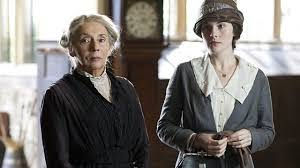
The flip-side to this distaff oasis is the sexual frustration running silently through the household (Ann fantasizes about her handsome--and hands-on--employer while other servants pine for their lost sweethearts), and the women's vulnerability. Significantly, in this version, Ann's fixation on the late lone male servant, Peter Quint, doesn't originate with her but is planted in her mind by Carla, a housemaid. Carla confides in Ann about how awful life at Bly was under Quint, who, as the only cock in the hen house, brutally used the unprotected women however he pleased. Ann becomes convinced that Quint's predilection for possessing whatever he wanted now extends to the youngsters in her care, innocents who were deliberately corrupted by the sins of Quint and their former governess, Emily Jessel.
The ghostly appearances are more overt than in earlier versions. In one of the best scenes, Miss Jessel appears seated in the back row of the classroom, grinning malevolently behind the children during their lesson. The children are more openly wicked, too. All hell breaks loose when Ann witnesses Miles abusing his little sister.

The biggest tell of all is that Ann isn't the first governess at Bly since Miss Jessel's suicide: a whole string of them have come and quickly gone, unable to withstand the sinister forces in the house.
These new touches enhance the menace of the story and give it a fresh coat of paint. It's an enjoyable adaptation that throws in surprises to alleviate the fatalism of events the viewer already knows are coming, either from repeated exposure to the story or from inferences gained in the opening scenes.

A couple of dangling issues do disrupt the suspension of disbelief. For one thing, it's never mentioned why Quint was at Bly instead of Passchendaele. Also, it's suggested that Ann will be taken from the asylum and executed for murder if she can't give a satisfactory explanation for her conduct. But why would authorities suspect the worst about her instead of exploring whether the child died of natural causes (e.g., a fit, a heart condition)? Also, if she is mad, wouldn't she be committed for life instead of killed?
Though not a faithful adaptation, this is certainly worth seeing.

Comments